From answers to evidence, design & defense.
A 64-mission learning journey that integrates mathematics, science, engineering, data literacy, coding, robotics, environmental systems, and responsible AI—culminating in Project AURORA.
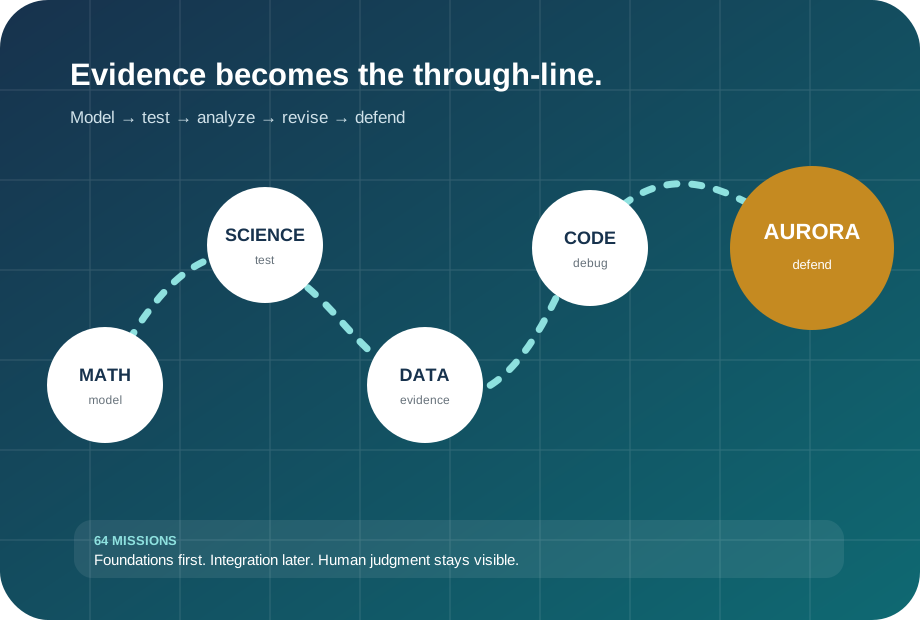
64 missions. One coherent progression.
Students build foundations first, then apply them in increasingly authentic systems and design challenges.
Requirements → prototype → autonomy → evidence fusion → final defense
Rigor you can see in student work.
Every mission asks students to make thinking visible through models, calculations, evidence, testing, revision, and explanation.
Build strong foundations
Quantitative reasoning, algebraic modeling, geometry, data, and scientific habits are developed before the most complex design work.
Test and revise
Failed tests, unusual data, debugging, limitations, and tradeoffs are treated as evidence—not something to hide.
Defend decisions
Students learn to connect claims to evidence and defend engineering choices, including the limits of what they know.
Eight strands. Increasing independence.
Quantitative Foundations
Operations, fractions, decimals, ratios, rates, percent.
Algebra & Modeling
Variables, equations, inequalities, coordinates, patterns.
Geometry & Fabrication
Measurement, area, surface area, volume, fabrication.
Data & Evidence
Statistics, sampling, probability, claims, uncertainty.
Scientific Discovery
Investigations, matter, energy, forces, CER, systems.
Earth & Environment
Watersheds, ecosystems, Chesapeake Bay, sustainability.
Coding, Robotics & AI
Algorithms, sensors, debugging, safe autonomy, AI checks.
Project AURORA
Requirements, prototype, autonomous mission, final defense.
A familiar structure that gradually releases responsibility.
The capstone is an evidence defense—not a showcase only.
Students define a real need, create measurable requirements, build an integrated system, test prototypes and autonomous logic, reconcile evidence, review AI-supported recommendations, and defend a final decision.
“I can show why it works, test it, improve it, and defend it.”
The program’s final standard is traceable evidence from problem → requirement → design → test → revision → recommendation.
See what students and teachers actually use.
Program Brochure
A concise school-facing overview of the 64-mission architecture, Project AURORA, and classroom publication package.
Open brochureSample / Preview Edition
Representative student experiences from quantitative reasoning through AURORA, including actual tasks and evidence prompts.
Open previewSchool Presentation
A concise overview for principals, teacher teams, partners, and program-review meetings.
Open deckReady to explore a school pilot?
Start with the preview, review the standards alignment, and discuss the implementation model that fits your setting.
See what students actually do.
Open the sample edition, explore the 64-mission architecture, or start a conversation about a school pilot.
Preview → discuss → pilot.
Schools can begin with a small, evidence-focused implementation conversation rather than committing to the full program immediately.
Preview
Review the sample edition, curriculum explorer, and teacher supports.
Discuss fit
Choose a classroom, STEM block, enrichment, intervention/extension, or after-school model.
Plan a pilot
Define scope, evidence to collect, teacher support, materials, and review checkpoints.